
If you are thinking about trying wingfoil, you have probably seen footage online that made you wonder: is this actually dangerous? Riders flying above the water on a hydrofoil, crashing at speed, boards flipping. It looks intense. And if you tried to replicate that on your own, it could be.
But there is a big difference between what you see on social media and what happens during a proper wingfoil lesson. Most of the risk associated with wingfoil comes from skipping the learning structure, not from the sport itself.
What People Worry About#
The concerns are understandable. A wingfoil setup includes a foil mounted under the board with a front wing, a mast, and a fuselage. The front wing has a leading edge that can cause cuts if you fall onto it at speed. The board is rigid. The wing generates pull. Put those together without guidance and you have a recipe for a bad time.
The most common fears:
- Getting cut by the foil. This is the one everyone asks about. The leading edge of the foil is not razor-sharp, but at speed it can cause a gash if you land on it.
- Falling onto the board. Rigid boards hurt if you fall face-first from standing height.
- Losing control of the wing. In strong wind, the wing can pull you off balance or drag you if you do not know how to depower it.
- Getting hit by the mast. The mast connects the board to the foil. In a wipeout, it can swing toward you.
These are real. They are not made up, and no one should pretend wingfoil is risk-free. But context matters. Nearly all of these scenarios happen when someone tries to learn alone, skips steps, or rides gear that is wrong for their level.
Why Self-Teaching Is Where the Risk Lives#
Most wingfoil injuries happen to people who skipped structured instruction. They bought gear online, watched a few tutorials, and went straight to riding in conditions they were not ready for.
The problem is that wingfoil has a specific learning curve. You need to be comfortable with the wing before you add the board. You need board balance before you add the foil. You need foil control at low speed before you try to ride fast. Each step builds on the previous one. Skip a step and the risks multiply.
A common example: someone stands on a foil board for the first time, the foil lifts unexpectedly, they panic, fall backward, and the board flips up with the foil attached. If no one showed them how to control the foil's lift or how to fall safely, that is when injuries happen.
This is not about talent or fitness. It is about sequence. Wingfoil taught in the right order is a manageable progression. Wingfoil attempted out of order is unpredictable.
How Proper Teaching Changes Everything#
When you learn wingfoil with a certified school, the structure exists specifically to remove the risks before they appear. Here is what that looks like in practice:
Step 1: Wing handling on the beach. Before you touch the water, you learn how the wing generates power, how to depower it, and how to hold it in different wind angles. You practise this on sand where there is zero consequence for mistakes.
Step 2: Big board without the foil. You get on a large, stable board and use the wing for propulsion, but the board sits flat on the water. No lift, no height, no speed. You learn balance and steering in a controlled setup. The big board is forgiving and hard to fall off.
Step 3: Board with a specific foil setup for controlled lift. Once your balance and wing control are solid, the foil is introduced with a setup designed to produce only small, slow lifts. You learn how the foil responds and how to control altitude without the risk of flying too high too fast.
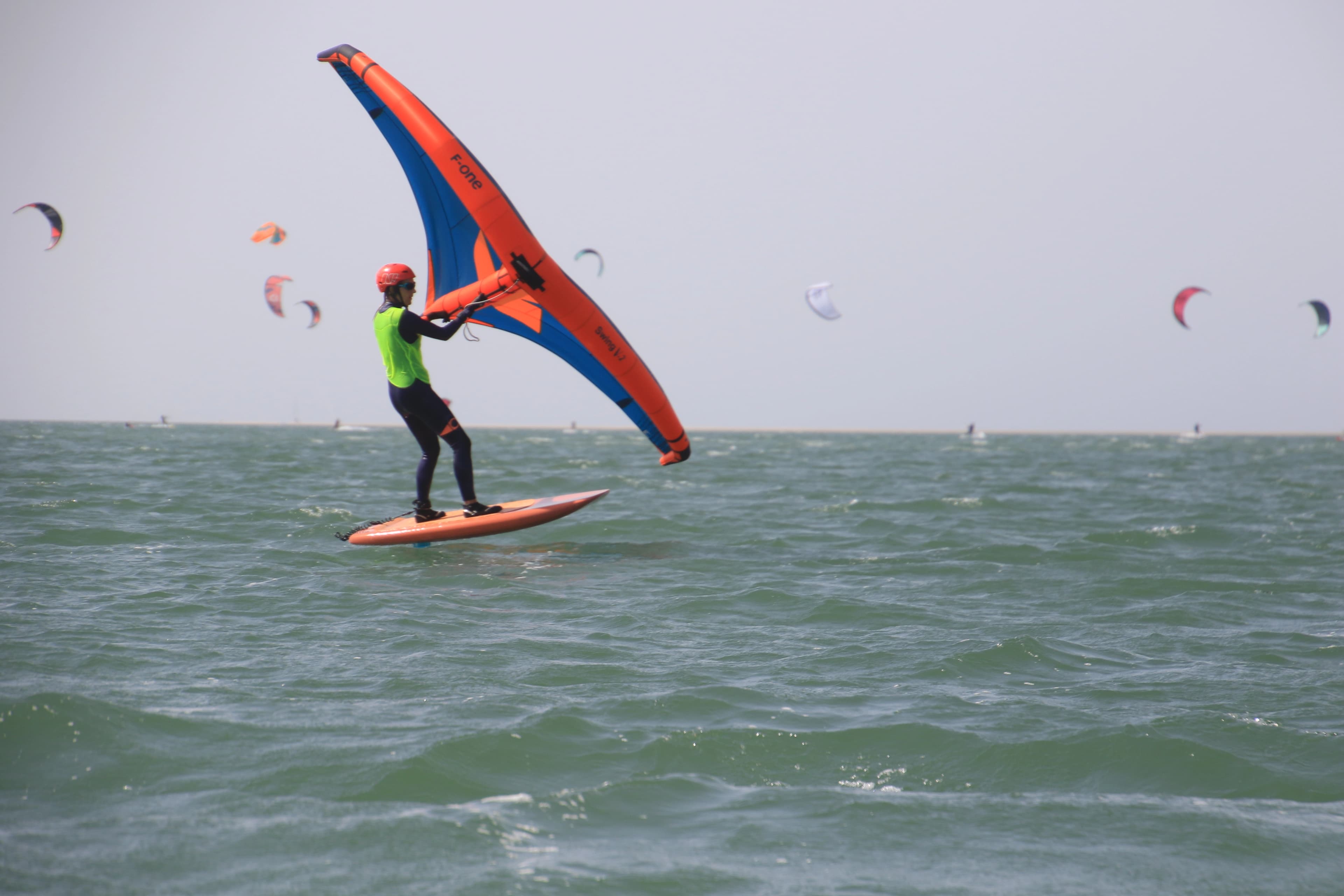
Step 4: Board with full foil setup. With lift control already understood, you move to a standard foil and begin building speed and altitude progressively. By this point, the foil is not a surprise. You already know what it does and how to manage it.
Each step removes a variable. By the time you are foiling, you already know how to handle the wing, how to balance on the board, and how to fall safely. The foil is not a surprise. It is the final layer on a foundation that is already stable.
Protective gear matters too. Helmets and impact vests are standard in lessons. They are not optional extras. A helmet protects against board contact. An impact vest absorbs falls onto the water surface at speed. The right gear does not make you invincible, but it covers the most common impact scenarios.
How Wingfoil Feels Compared to Kitesurf and Surf#
All three sports involve the ocean, a board, and a learning curve. But the experience on the water is different for each one.
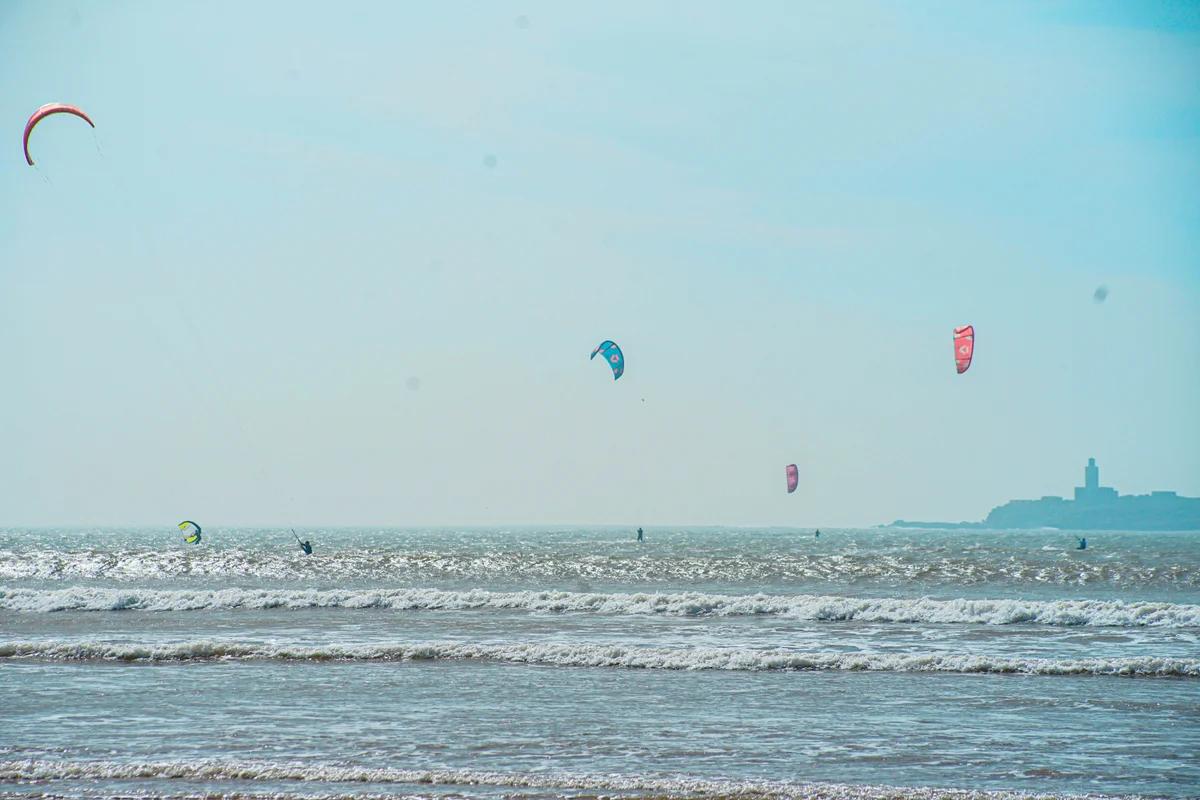
- Wingfoil vs kitesurfing: In kitesurfing, you are connected to a kite by lines. The kite generates power and you manage it through a bar. It is a connected feeling, like driving something. In wingfoil, you hold the wing directly in your hands. You can release it at any moment. There are no lines. The sensation is more independent, more like flying something yourself rather than being pulled by something else.
- Wingfoil vs surfing: Surfing is about reading the ocean, catching waves, and riding their energy. Wingfoil uses wind instead of waves as the power source. You generate your own momentum with the wing, which means you do not need to wait for the right wave. The foil adds a dimension of height and glide that surfing does not have. Different feelings, different rhythms.
Each one is its own experience and its own way to enjoy the water.
What We See on the Water Every Day#
We teach wingfoil beginners daily across Dakhla and Essaouira. The reality of what happens in lessons is not what social media shows.
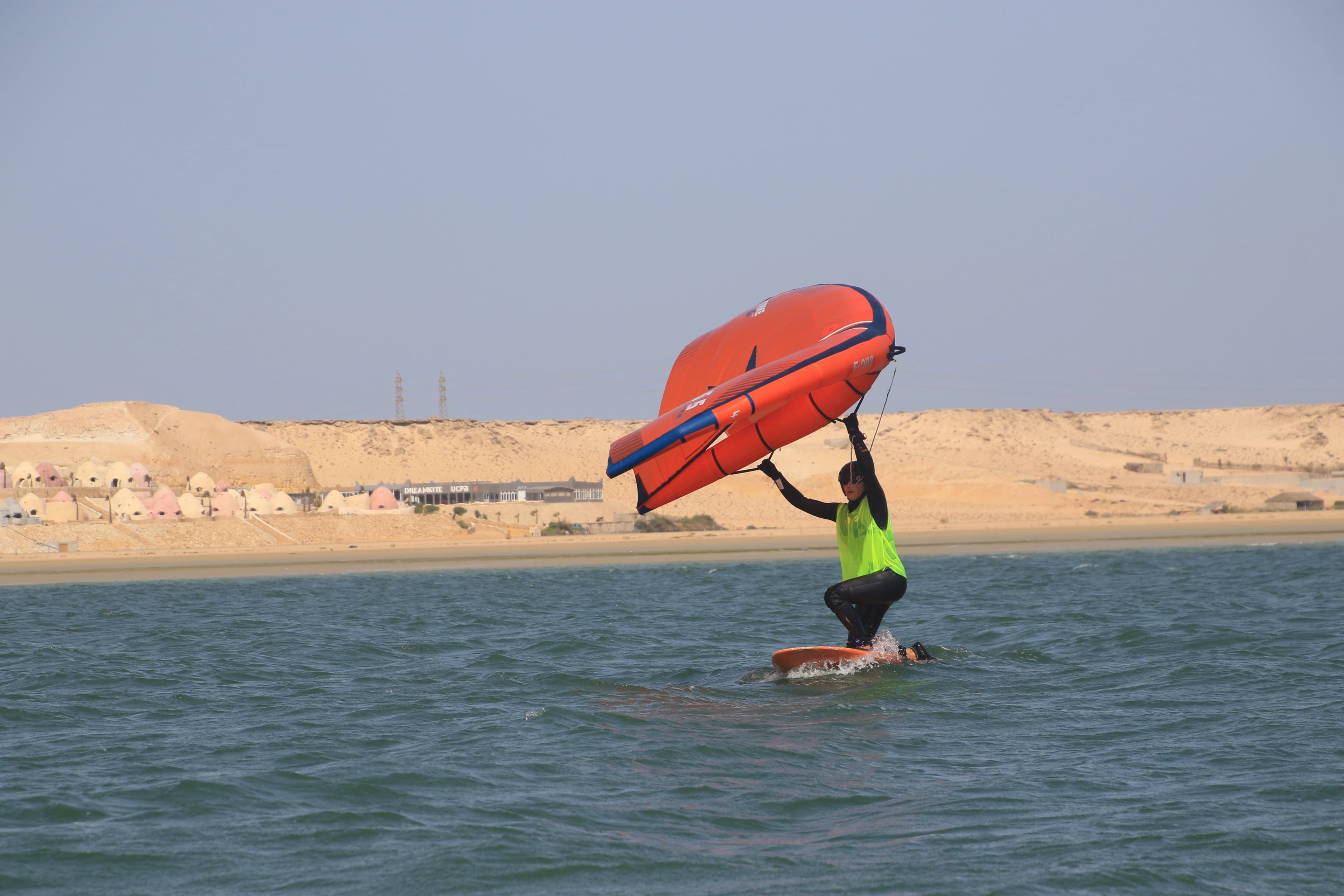
Most beginners spend their first session laughing, falling into warm flat water, and slowly figuring out how to keep the wing at the right angle. No one is flying above the water on day one. No one is hitting high speeds. The foil does not even come out until the fundamentals are in place.
The most common "injury" we see in beginner lessons is sore forearms from gripping the wing handles too hard. That is about it.
The progression from first wing handle to riding on the foil typically takes several sessions. Each one builds incrementally. There is no moment where a beginner is suddenly in a high-risk situation they were not prepared for, because the methodology does not allow it.
The Short Answer#
Is wingfoil dangerous? It can be, if you skip the learning structure. The equipment has real potential to cause injury when used without proper technique and progression.
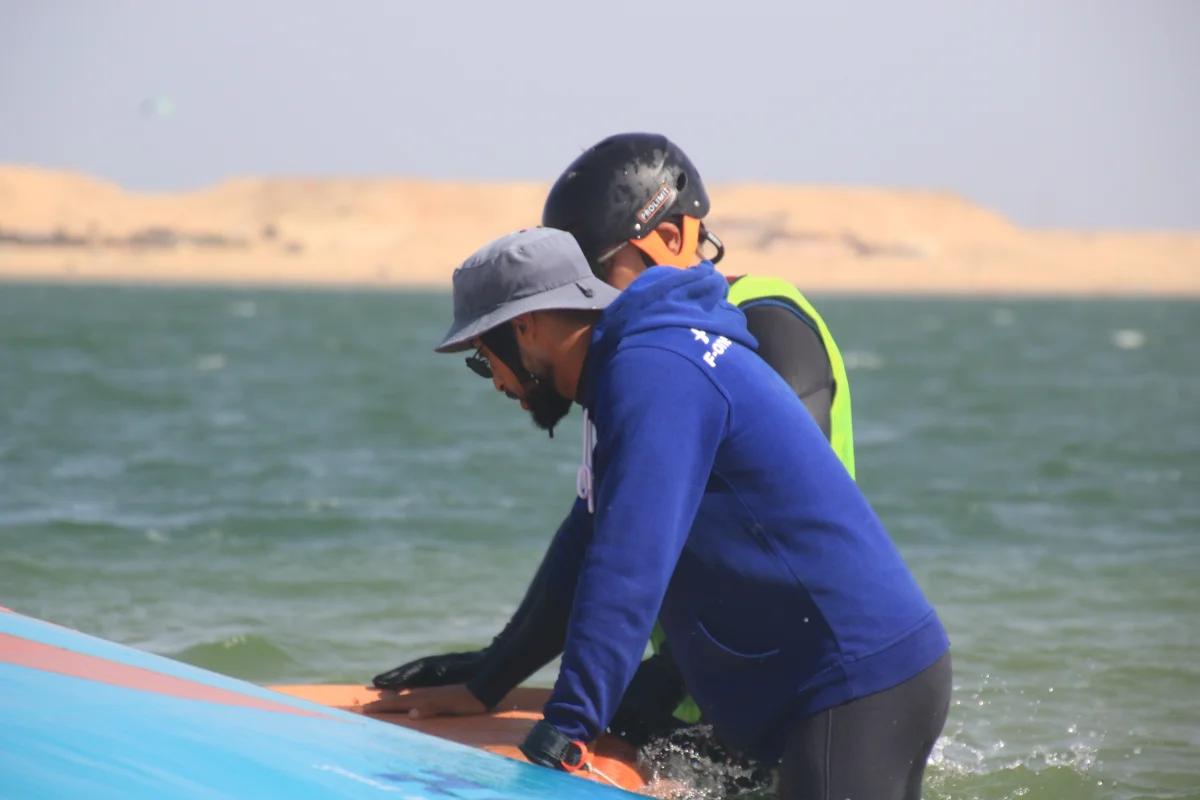
With certified instruction, the risks are managed step by step. You do not touch the foil until you are ready. You wear protective gear. You learn in conditions matched to your level. And someone who has done this hundreds of times is standing next to you, watching for the exact mistakes that lead to problems.
The question is not really whether wingfoil is dangerous. It is whether you want to learn it properly or figure it out the hard way.
Ready to start? Check wingfoil lesson formats and availability or book your sessions directly.
Frequently Asked Questions#
Do I need to be fit to try wingfoil?
A basic level of fitness helps, but you do not need to be an athlete. The main demands are grip strength and core balance. Both develop quickly during the first few sessions.
Can kids learn wingfoil?
Yes. With the right gear sizing and instructor supervision, wingfoil is accessible to younger riders. The team adapts the session to the child's comfort and strength.
Is the foil actually sharp?
The leading edge of the foil is not blade-sharp, but it is hard and narrow. At speed, it can cause cuts. This is why beginners do not use the foil until their board control and falling technique are solid.
Do I need previous board sport experience?
No. The teaching methodology starts from zero. Experience with surfing, kitesurfing, or SUP helps, but it is not required.
What protective gear is used in lessons?
Helmets and impact vests are standard. Wetsuits also add a layer of protection. The gear is provided by the school.
What happens if I fall onto the foil?
At beginner speeds, falls are low-impact. The teaching progression ensures you are not riding at speeds where foil contact would be dangerous before your control is ready for it.
Is it safer to learn in flat water or ocean?
Flat water (like Dakhla's lagoon) offers a calm environment where you focus purely on wing and foil control. Ocean conditions (like Essaouira) develop a different skill set that includes reading the water and adapting to movement. Both work with proper instruction and both produce confident riders.
Can I teach myself wingfoil with online tutorials?
You can try, but this is where most injuries happen. Online tutorials cannot correct your technique in real time, cannot assess whether you are ready for the next step, and cannot intervene when something goes wrong. A certified instructor does all three.
Our team has taught hundreds of wingfoil beginners across Dakhla and Essaouira. This article reflects what we see daily on the water, not theory.